How Gold Prices Are Calculated: From Ounce to Gram
Learn how the gram price of gold is worked out from the global ounce price, the exchange rate and karat purity, plus the jeweller's spread and making charge.
By Editorial team7 min read
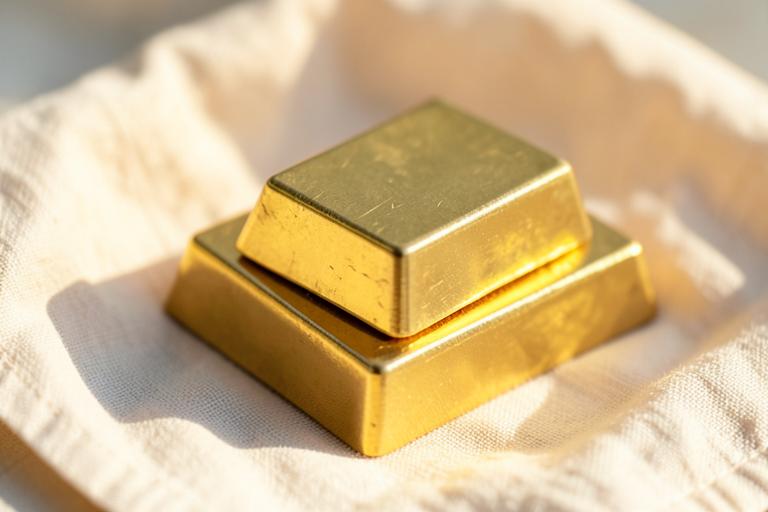
The price of a gram of gold is worked out in a few simple steps: take the global gold price per ounce in US dollars and divide it by 31.1035 (the number of grams in a troy ounce), multiply the result by the dollar exchange rate in your currency, then multiply by the purity of the karat you want (for example 0.875 for 21K). The jeweller then adds a profit margin, and a making charge is added if the item is jewellery rather than a bar. The prices in this article are for illustration only and are not real prices.
When you search for "gold price today" you see a single figure for each karat, but that figure is the end of a short chain of calculations. Understanding that chain lets you check any quote you are given, and understand why the shop next door differs by a small amount.
Step one: the ounce price in dollars
Gold is priced globally in US dollars per troy ounce, and a troy ounce equals 31.1035 grams (it is not the same as the ordinary ounce used for food). This price moves throughout trading days with supply and demand in global markets, and it is often called the "spot price".
To turn it into a price per gram, divide by 31.1035:
Price of a gram of pure gold in dollars = ounce price ÷ 31.1035
Step two: converting to the local currency
Multiply the dollar price per gram by the dollar exchange rate in your local currency. Here is an important point: in countries where there are several exchange rates, or where the bank rate differs from the market rate, dealers usually use the rate at which they can actually secure gold or dollars, not necessarily the official rate. So you may see a difference between your calculation and the shop's price even if both are accurate.
Step three: multiplying by the karat factor
Karat expresses the purity of gold out of 24 parts: 24K is pure gold, and the remainder in lower karats is a mix of other metals added to make the gold stronger. Since prices are mainly published for 24K, the other karats are calculated by proportion:
| Karat | Share of pure gold | Multiplier |
|---|---|---|
| 24 | about 99.9% | 0.999 (rounded to 1) |
| 22 | 91.7% | 0.917 |
| 21 | 87.5% | 0.875 |
| 18 | 75% | 0.75 |
| 14 | 58.3% | 0.583 |
The page gold price in Egypt shows each karat separately, so you can compare what you calculate yourself with the published prices.
A worked example (illustrative numbers)
This example uses round numbers to make things easy to follow. It is not a real price.
Assume the ounce price is 3,110 dollars and the dollar is worth 50 Egyptian pounds:
| Step | Operation | Result |
|---|---|---|
| Price of a 24K gram in dollars | 3,110 ÷ 31.1035 | about 100 dollars |
| Price of the gram in pounds | 100 × 50 | 5,000 pounds |
| Price of a 21K gram | 5,000 × 0.875 | 4,375 pounds |
| Price of an 18K gram | 5,000 × 0.75 | 3,750 pounds |
So in this example the price of a gram of 21K gold is about 4,375 pounds before any additions. The Egyptian gold pound weighs 8 grams of 21K, so the gold in it is worth 8 × 4,375 = 35,000 pounds in the same example.
You can try your own figures with the gold calculator instead of working them out by hand.
Sell price and buy price: the dealer's margin
In a shop you will see two prices for the same gram:
- Sell price: what you pay when you buy.
- Buy price: what the shop pays when it buys gold from you.
The difference between them is the dealer's margin. It covers the dealer's costs and the risk of the price moving while the gold is held. In the previous example the sell price might be 4,375 pounds and the buy price a little lower. How wide or narrow the gap is depends on the market, the shop and the level of demand.
The making charge: why it is not like the gram price
The making charge is the fee for manufacturing and designing the piece. It is usually added per gram (or as a percentage of the value, or as a fixed amount per piece, depending on local custom). It depends on:
- The complexity of the design: a simple chain carries a lower making charge than a stone-set or hand-worked piece.
- The type of piece: a ring's making charge differs from a wedding band's or a full set's.
- The shop itself, its reputation and its costs.
Bars and gold coins usually carry a lower making charge (or premium), which is why people buying for saving often prefer them. One important point: when you resell jewellery, the shop usually does not pay for the making charge, so the value is calculated on the weight of gold alone.
Why does the shop price differ slightly from your calculation?
Even if you follow the steps exactly, you may find a small difference between your figure and the shop's price. Some reasons:
- Price movement: the ounce price and the exchange rate change by the minute, and shops update their prices at intervals.
- The exchange rate used: each dealer may base the calculation on a slightly different dollar rate.
- Rounding: many shops round the price to a convenient figure.
- Margin and local supply and demand: if demand for a particular karat rises, its premium may rise for a while.
That is why some price sites in Arab countries rely on actual local market prices rather than pure calculation, since reality can differ from the theoretical figure.
Practical tips before buying or selling
- Calculate the theoretical price first, as in the example, to see how close the shop's offer is to the arithmetic.
- Ask about the making charge clearly and have it written on the invoice separately from the gram price.
- Check the hallmark and karat; in Egypt, jewellery is hallmarked by the assay authority (Hallmarking and Scales Authority, مصلحة الدمغة والموازين).
- Compare at least two shops, and compare both the sell price and the buy price, not just one of them.
- Keep the invoice; it is your reference when you resell or exchange.
- Remember that displayed prices are indicative and change constantly; what counts is the shop's price at the moment of the transaction.
How to read a gold invoice
A good invoice separates the components of the price, and this is what makes comparison possible. Look for:
- The weight of the piece in grams, ideally with the net weight of gold stated if the piece is set with stones.
- The karat, clearly written (21 or 18, for example).
- The gram price applied at the time of purchase.
- The making charge as a separate line, and how it was calculated (per gram or per piece).
- Any taxes or fees added, if there are any.
Suppose in our example a 21K bracelet weighs 10 grams and the shop charges a making charge of 200 pounds per gram. The gold is worth 10 × 4,375 = 43,750 pounds, the making charge is 10 × 200 = 2,000 pounds, and the total is 45,750 pounds (illustrative numbers only). If you are asked for a much higher amount, ask about the reason for the difference before paying.
Common mistakes when calculating the gold price
- Confusing the troy ounce with the ordinary ounce: the troy ounce is 31.1035 grams, while the ordinary ounce is about 28.35 grams, a mistake that changes the result by about 10%.
- Forgetting the karat factor: some people multiply the 24K price directly by the weight of a 21K piece.
- Counting the gross weight of a stone-set piece: stones and enamel are not counted as gold when you resell.
- Comparing one shop's sell price with another's buy price: compare each price with its counterpart.
- Relying on an old figure: prices change during the day, so check when the price was published.
Summary
Price per gram = (ounce price ÷ 31.1035) × exchange rate × karat factor, after which the shop adds its margin and the making charge. Knowing this formula, you can read any price you see when you look up "gold prices today" more clearly and compare it with what you are offered.
Frequently asked questions
How do I calculate the price of a gram of 21K gold from the ounce price?
Divide the ounce price in US dollars by 31.1035 to get the price of a gram of pure gold, multiply it by the dollar exchange rate in your currency, then multiply by 0.875 (the purity of 21K).
Why does the shop price differ from the price I calculate myself?
Because the shop adds a profit margin, is affected by the real exchange rate in the local market, and rounds its figures. Prices also move throughout the day, so the number you calculated may already have changed by the time you arrive.
What is the difference between the sell price and the buy price of gold?
The sell price is what you pay the shop when you buy; the buy price is what the shop pays you when you sell your gold. The buy price is lower, and the difference is the dealer's margin.
Is the making charge included in the price per gram?
No. The making charge is a separate fee added on top of the gram price for manufacturing and design. It varies from piece to piece and shop to shop, and it is usually not refunded in full when you resell the piece.