Gold Investing for Beginners: Forms, Costs and Mistakes
A beginner's educational guide to saving in gold: jewelry versus coins versus bars, hidden costs, liquidity, the right time horizon and common buyer mistakes.
By Editorial team7 min read
This article is general education, not financial advice or a recommendation to buy or sell. Saving in gold means buying physical gold (jewelry, coins or bars) and holding it for years as a store of value; it does not pay regular income like interest or rent. Your outcome depends mostly on three things: the form you buy, the costs you pay on the way in and out, and how long you can hold without needing to sell.
Why do people save in gold?
Many people in the Arab world turn to gold because it is a familiar, widely accepted commodity that is relatively easy to sell at jewelers, and because its global price is set in US dollars, some see it as a way to protect part of their savings when the local currency swings or prices rise. But this idea has limits you should know from the start:
- Gold does not guarantee a profit; its price rises and falls, and it can stay low for years.
- It pays no regular return; your only gain is the difference between the buy and sell price.
- Buying and selling costs can eat part of the gain, especially over the short term.
To understand what influences the price, see our article on what moves gold prices, and to follow quoted prices visit the gold price in Egypt page.
The three forms: jewelry, coins and bars
| Form | Making charge or premium | Ease of selling | Best suited to someone who |
|---|---|---|---|
| Jewelry (21K or 18K) | High making charge, usually not recovered | Easy, but minus the making charge | Buys for adornment and wear first |
| Gold coins (such as the gold pound) | Relatively small premium | Easy, in small units | Saves medium amounts in stages |
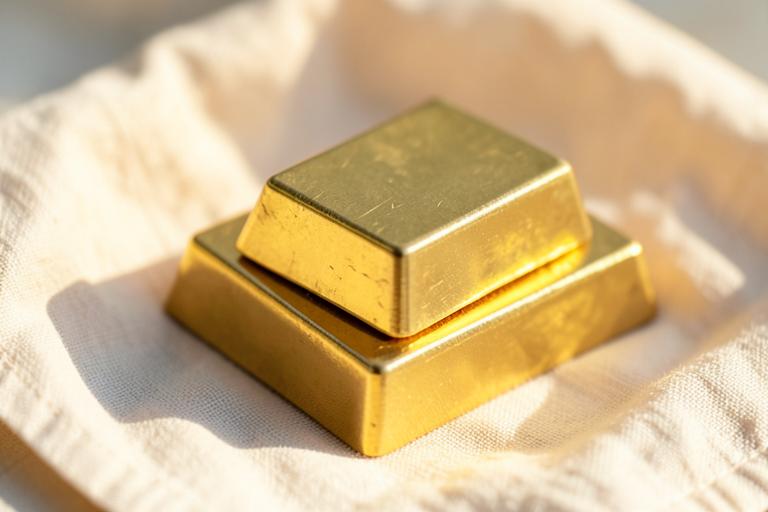
| Bars (24K) | Usually the lowest, falling as weight rises | Good with sealed packaging and a certificate | Saves larger amounts |
Jewelry is the closest to our culture, but it mixes adornment with saving, and the price of the adornment (the making charge) usually does not come back when you sell. Coins such as the gold pound combine a fixed, well-known weight with easy trading. Bars usually offer the lowest cost per gram, but they need to be bought from a trusted source and you must keep the certificate and packaging. For a detailed comparison read gold bars vs jewelry.
In some markets there are also funds and certificates linked to the gold price. They have their own terms, risks and rulings that differ from country to country, and this article does not cover them; the rule is to understand any product before buying it and to check that the seller is licensed.
Costs that do not show in the price per gram
The quoted price per gram is not everything you will pay or everything you will receive. There are:
- The buy-sell spread: you buy at the selling price and sell at the lower buying price.
- The making charge or premium when you buy.
- Storage and insurance costs if you use a bank safe or an insurance policy.
- Taxes and fees, which differ from country to country; ask about them rather than assuming a particular rate.
A worked example (illustrative numbers)
Suppose a shop sells a gram of 21K for 4,400 pounds and buys it back for 4,300 pounds, and that the making charge on jewelry is 200 pounds per gram:
| Case | What you pay per gram | What you get per gram when selling | Difference |
|---|---|---|---|
| Coin or bar with almost no making charge | 4,400 | 4,300 | 100 (about 2.3%) |
| Jewelry with a 200 making charge | 4,600 | 4,300 | 300 (about 6.5%) |
This means the price must rise by at least that much for you to get back what you paid, which is why gold suits people with a long time horizon and usually does not suit someone looking for a quick gain. For more on this point see our article on making charges in gold.
Liquidity and time horizon
Gold is usually easy to sell in our markets: you go to a well-known shop, it assesses weight and karat and pays you the same day. But liquidity does not always mean a good price, because you sell at the buying price, not the selling price. The problem shrinks when the gold is documented with an invoice, a certificate and intact packaging.
As for time, the general rule is that money you may need within months does not belong in gold, because the price may be lower than what you paid when you need it, and the costs will not have had time to be absorbed. It is often suggested to build a cash emergency fund first, and only then think about saving in gold with surplus money.
Gold in your local currency: a point many overlook
The price per gram you see in your country is the result of two things together: the global gold price in dollars and your currency's exchange rate against the dollar. So gold may rise in your currency even if it did not move globally, if the currency weakens, and it may fall if the currency strengthens. This means gold is not "stable" in the sense that its price does not change; it is an asset that moves with global and local factors at once, and anyone saving in it needs patience and realistic expectations rather than waiting for quick results.
How much should you allocate to gold?
There is no correct percentage for everyone; it depends on your income, obligations, goals and tolerance for price swings. A general principle of financial planning is that no single asset should be everything you own, and that the share put into gold should come from money you will not need soon. If you have large obligations, consult a licensed financial professional before deciding.
Simple steps to start
- Define your goal and its timeframe: marriage, education or long-term saving; the goal decides the right form.
- Work out your budget in grams, not just in money, and try your numbers in the gold calculator.
- Choose the lowest-cost form for your goal, and remember the price of the making charge.
- Buy from a known source and ask for an invoice stating weight, karat, price per gram and making charge.
- Consider buying in instalments rather than all at once, as we explain in the best time to buy gold.
- Plan storage from day one, and read how to store your gold safely.
- Do not forget zakat: saved gold may be subject to zakat if it reaches the nisab and a lunar year passes; you can estimate it with the zakat calculator.
Common beginner mistakes
- Buying high-making-charge jewelry as an investment, then discovering that much of what was paid does not come back.
- Putting all your savings into one asset; diversification reduces the effect of a fall in any single price.
- Buying with borrowed money or money you will soon need.
- Chasing the news: buying at every price jump out of fear of missing out.
- Neglecting the invoice and certificate, which are your reference when reselling.
- Forgetting storage; gold lost to theft or misplacement is not protected by any rise in price.
- Buying from unknown sellers because of a tempting price; for caution, read our article on spotting fake gold and reading the hallmark.
Conclusion
Saving in gold suits some goals and some people and not others, and there is no percentage, timing or form that is right for everyone. Start by understanding the costs, choose the form with the lowest making charge for your goal, save with money you will not need soon, and document your purchases. And remember that this article is educational only, and the figures in the examples are illustrative, not real prices.
Frequently asked questions
Is gold a guaranteed profit?
No. The gold price rises and falls and can stay low for years, and gold pays no regular income such as interest or rent. What is written here is general education, not financial advice.
Which is cheaper for saving: jewelry or bars?
Bars and gold coins usually carry a lower making charge or premium than jewelry, and the making charge on jewelry is usually not recovered when you sell. That is why bars and coins suit people who buy purely to save.
How long should I hold gold before selling?
There is no fixed period, but the gap between the buy and sell price makes short holding expensive. It is better to save with money you will not need soon and with a horizon of several years.
Can I start with a small amount?
Yes. You can start with small coins or bars, or buy in several instalments, bearing in mind that smaller units often carry a relatively higher premium per gram.